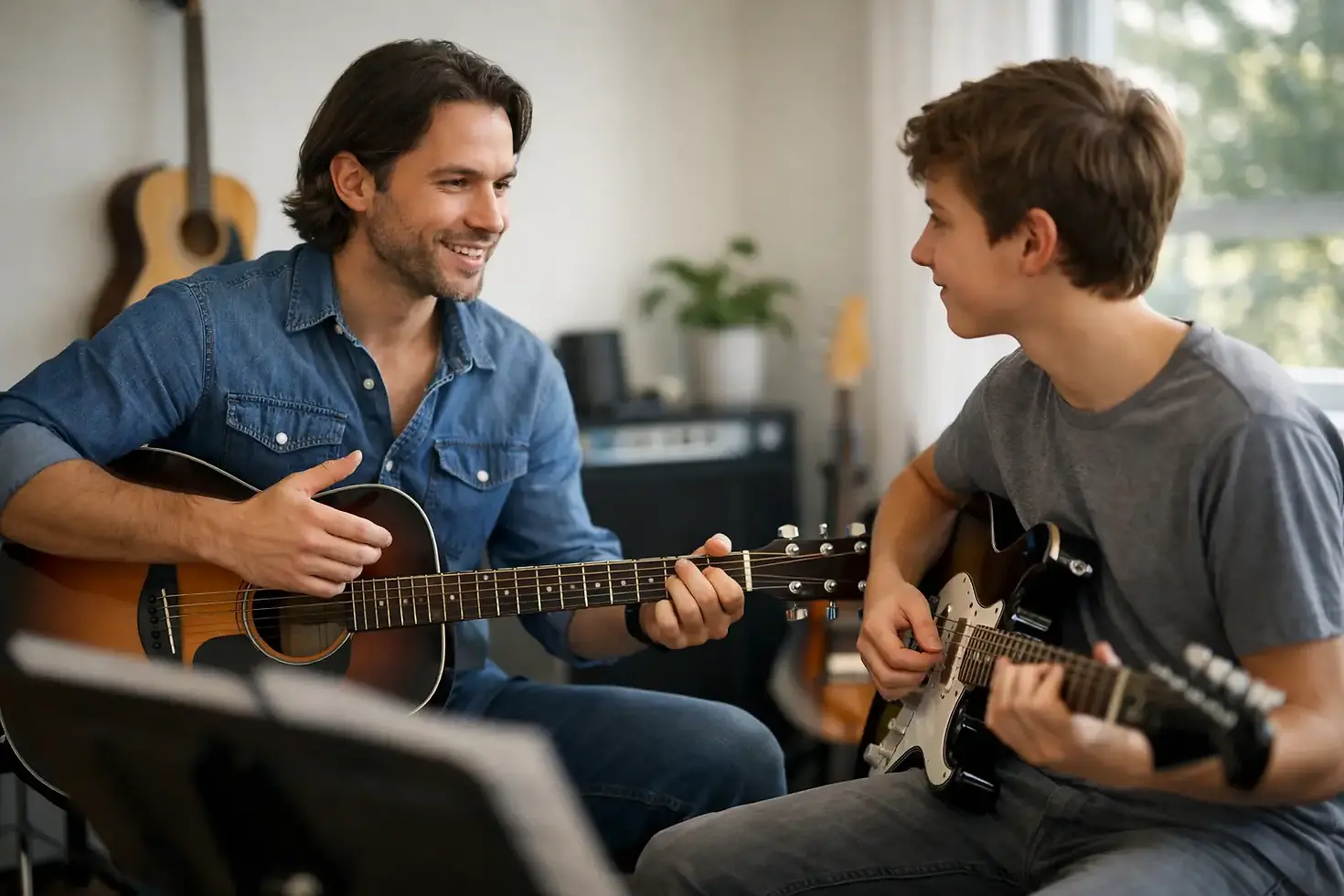
How an Ottawa Guitar Teacher Builds Real Progress
- Aug 10
- 5 min read
A good Ottawa guitar teacher does more than show a student where to put their fingers. They help make guitar feel possible on a Tuesday evening after work, between a child’s school and sports schedule, or when a returning player is trying to remember why they loved music in the first place. The right lesson creates a clear next step, then makes that step enjoyable enough to repeat.
That matters because most people do not stop playing guitar because they lack interest. They stop when practice feels confusing, progress is hard to hear, or lessons do not fit real life. Private instruction works best when it meets the student where they are - musically, practically, and personally.
What a Great Ottawa Guitar Teacher Should Adapt To
No two students arrive with the same goal. A seven-year-old may want to play a favorite song and feel confident at a school recital. A teenager may be working toward electric guitar riffs, improvisation, or joining friends in a band. An adult beginner may want a creative break from a busy week, while a returning player may need help rebuilding rhythm, chord changes, and reading skills.
A thoughtful teacher adjusts the lesson around those goals instead of putting every student through the same sequence at the same speed. That does not mean skipping the fundamentals. It means teaching fundamentals in a way that feels connected to the music a student wants to play.
For one student, clean chord changes might be the focus because they want to sing along to acoustic songs. For another, the priority may be fretting-hand position and picking control for electric guitar. Bass students may need stronger timing and an understanding of how to support a groove. Ukulele students often benefit from simple, rewarding songs early on, while still learning steady rhythm and proper technique.
Personalized teaching also means paying attention to how a student learns. Some people understand quickly by seeing chord diagrams or TAB. Others need to hear a phrase, play it back, and repeat it slowly. Some enjoy music reading; others gain confidence by learning songs first, then connecting the notes on the page to the sounds they already know. A patient instructor can use all of these approaches without making the student feel behind.
Learn Where You’re Comfortable
Convenience is not a small detail in music education. It is often the difference between a lesson plan that lasts two months and one that becomes a meaningful part of a student’s life.
For families, in-home lessons remove the weekly rush of packing up an instrument, driving across town, waiting through a lesson, and heading home again. A child can learn in a familiar setting, with a parent nearby if needed. That comfort can be especially helpful for younger beginners and students who are initially shy about playing in front of someone new.
Adults benefit from the same practical advantage. When the lesson comes to your home, it is easier to keep a regular commitment. Your guitar is already there. You can finish work, make a cup of coffee, and spend focused time on something that belongs to you. Online lessons offer another flexible option for students whose schedules, locations, or routines make travel difficult.
There is a trade-off, of course. Some students enjoy the energy of going to a music studio and being surrounded by instruments and other musicians. But for many Ottawa-Gatineau households, home or online instruction makes consistency much more realistic. Consistency is where progress starts to become visible.
The Skills That Make Playing Feel Easier
A student does not need to choose between playing real songs and learning proper technique. The best lessons do both, with the balance changing as the student develops.
At the beginning, a player needs a few practical wins: how to hold the instrument comfortably, tune it, make a clean sound, understand simple rhythm, and move between a small set of chords. Those early pieces can lead to songs surprisingly quickly. Hearing a recognizable progression after a few lessons is powerful motivation.
As confidence grows, instruction can become more detailed. Students may work on finger strength, alternate picking, strumming patterns, scales, barre chords, muting, dynamics, ear training, or basic theory. They can learn to read standard notation, use chord charts, and follow TAB. Each tool has a purpose. TAB is direct and useful for learning riffs and songs, while reading music helps students understand rhythm, pitch, and musical structure more deeply.
The key is not to overload a student with information. A beginner who receives ten exercises may practice none of them. A better approach is to choose a small number of clear tasks, explain why they matter, and connect them to the next song or skill. Learn smarter, not harder.
Measurable Progress Keeps Motivation Alive
Progress should be something a student can hear and feel. Maybe a chord change that once took five seconds now happens in time. Maybe a student can keep a steady beat through an entire song, read a short melody, or play a riff without stopping. These are real milestones, even when they seem small.
A strong teacher notices those improvements and uses them to set the next goal. This gives students a sense of direction instead of the vague feeling that they are practicing but not getting better. It also helps parents understand what their child is learning and why regular practice matters.
What Practice Should Look Like Between Lessons
Practice does not need to be long to be effective. Especially for children and busy adults, a short, focused routine is usually better than waiting for one perfect hour that never arrives.
A teacher can help create a routine that feels manageable: a few minutes of warm-up or finger exercise, a targeted chord or scale, a rhythm pattern, and a section of a song. The exact structure depends on the student. Someone preparing for a performance may spend more time on complete run-throughs. A new player may need slower work on two chord changes and a simple strumming pattern.
The goal is not perfection at home. Practice is where students experiment, make mistakes, and build familiarity. Lessons are where they get feedback, solve problems, and discover what to work on next. When students know that mistakes are part of the process, they are more likely to keep picking up the instrument.
Choosing the Right Fit for Your Family
When looking for a guitar teacher, credentials and experience matter, but so does the feeling a student has during the lesson. A skilled instructor should be able to explain a concept clearly, listen carefully, and adjust when something is not clicking. They should take a student’s musical interests seriously, whether the goal is classical reading, rock guitar, folk songs, pop chords, bass lines, or ukulele strumming.
For parents, it helps to look for someone dependable, patient, and able to communicate progress in plain language. For adults, look for a teacher who respects your starting point. You do not need to know theory, own an expensive instrument, or have played before to begin. You only need a willingness to show up and try.
Laffy Stone Music offers private acoustic guitar, electric guitar, bass, and ukulele lessons in homes and online across the Ottawa-Gatineau area, with instruction available in English and French. The focus is simple: personal lessons, practical skills, and music that keeps students motivated to continue.
Give the First Lesson a Clear Purpose
A first lesson should not feel like a test. It is a chance to understand the student’s experience, goals, musical taste, instrument, and schedule. From there, a teacher can build a path that has enough structure to create results and enough flexibility to stay fun.
Whether you are helping a child find their first favorite song, returning to guitar after years away, or finally making time for an instrument you have always wanted to learn, start with a lesson format that makes continuing easy. A guitar on a stand, a few focused minutes of practice, and the right encouragement can turn a passing interest into a lasting part of your week.


